Eco Friendly Printer

Eco-friendly folders are typically created using recycled paper, recyclable coatings, and vegetable-based inks, as well as other materials and processes that have a minimal impact on the environment. Company Folders, Inc. is committed to the well-being of planet Earth, and we want future generations to enjoy living here as much as we do. That's why we're dedicated to preserving the environment through the use of eco-friendly practices whenever possible.
Ink made from natural vegetables
You can rest easy knowing that the ink in your product isn't toxic to your health—or the planet's. We use vegetable-based inks made from at least 45% renewable content. Unlike petroleum-based inks, which often contain high levels of VOCs (volatile organic compounds) and can cause health risks and air pollution, vegetable-based inks are naturally low in these chemicals.
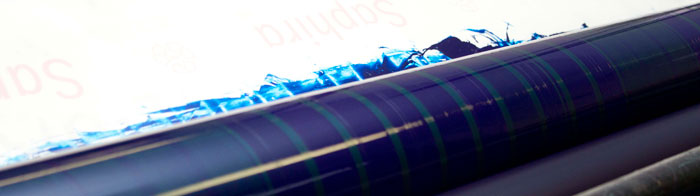
What's good for the Earth is also good for the quality of your product. Our eco-friendly agricultural-based inks use high-solid, quick-set technology to produce rich, vibrant colors and crisp detail. Soy inks often get a bad reputation for drying slowly, but our inks dry quicker than normal, drastically reducing your production time.
Paper stocks that actually save trees
We want your great-great-grandchildren to be able to enjoy our planet's trees and forests. That's why a number of our stocks are made from recycled content—not just the post-consumer waste that eco-conscious people like you throw into recycling bins, but also pre-consumer waste like the scraps of paper left over after paper products are die-cut.
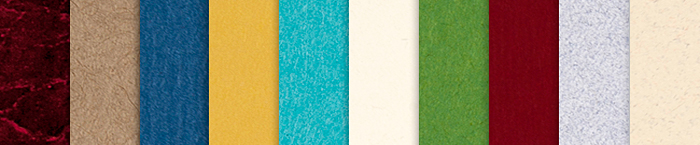
To take advantage of paper's renewable nature, many of our stocks are also made from materials taken from sustainably managed forests. When trees are cut down and turned into paper, new trees are planted in their place.
Protective coating that protects the planet
You'll be happy to hear that all our standard aqueous coatings—gloss, matte, satin and soft-touch—are water-based and safe to recycle. Ultraviolet (UV) coating is 50% renewable with 30% soy content, and can be recycled with other mixed wastes.
Printing your product the eco-friendly way
 It's not just the materials we use, but the way that we use them that ensures your final product is as eco-friendly as possible. We've carefully considered every detail, even the printing plates used in the production of your marketing materials. We monitor and replenish our plate developer to extend the life of every plate and make sure none go to waste. We also recycle our metal printing plates and the dies used in foil stamping and embossing.
Our motto is "waste not, want not." Our presses are equipped with automatic registration systems that reduce make-ready waste. Additionally, all of the ink we print is controlled by a computer with digital scales to minimize ink waste.
You know how mixing all the colors together gives you black? Whenever we have leftover ink, we re-blend it with other colors to create black ink. We don't waste a drop if we don't have to.
To make sure we don't have to print more products to correct color errors, we use a job scheduling system to minimize color changes. We always try to run the lighter colors before the darker colors, or group colors together whenever possible, requiring less press clean-up.
When it comes time for cleaning, we keep it green. Any wash-up waste that's generated is taken in by our solvent recovery system and automatically recycled into new solvent.
We minimize paper waste whenever possible by optimizing the sheet size and layout of projects. Any scrap paper that's left over is separated by color, baled, and recycled. Baling the scraps makes it more efficient to store and ship the paper to recycling plants.
Do you turn the light off when you leave the room? So do we. Our occupancy sensors turn off the lights whenever an area is not in use, to cut back on our energy consumption. When the lights are on in our manufacturing and warehouse areas, we're running energy efficient lighting that not only saves on energy, but also improves safety and productivity.
Working together to save the planet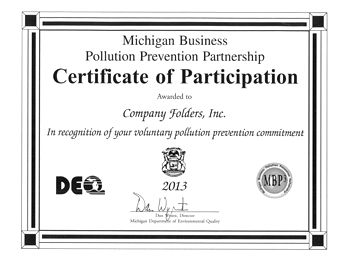
It takes more than just one folder company to save the world—that's why we've teamed-up with other like-minded businesses. We're a registered member of the Michigan Business Pollution Prevention Partnership (MBP3). This is a voluntary program developed through a joint effort by industry professionals and the Michigan Department of Natural Resources and Environment (MDNRE).
The MBP3 encourages and helps businesses to reduce air, water and waste discharges, both hazardous and non-hazardous. We encourage your business to stand with us. Together we can make a real difference—not just for Michigan, but for the entire world.
For more information on the Michigan Business Pollution Prevention Partnership, visit the Michigan.gov Department of Environmental Quality.
Go green on your next print job with our most eco-friendly products
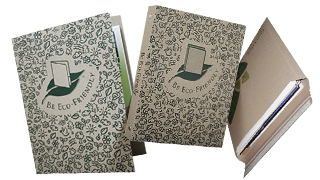 Take that first step towards making the world a greener place by ordering some of our most eco-friendly products. Our Two-Pocket Kraft Presentation Folder has ample storage space, complementary business card slits and stock made from 100% recycled material, accentuated by a woody, natural look. If the stock doesn't send the message, then say it loud and proud with an optional eco-tag, completely free of charge.
Need more storage space than a folder will allow for? Our Eco Friendly Two-Pocket 3-Ring Binder can fit more materials, thanks to the spine attachment and metal bindings. It even comes in 100% recycled eco white smooth stock, which looks just like normal white stock without using chlorine to bleach the paper.
Before you send out your recycled folder in a non-recycled envelope, consider our Eco-Friendly Large Conformer Expanding Mailer Envelope. Let's face it—even custom designed envelopes are likely to be discarded eventually. Using an envelope made from 100% post-consumer helps offset this waste and encourages recipients to recycle their discarded envelopes.
 Like us on Facebook
 Follow us on Twitter
 Follow us on Pinterest